
Guided surgery that goes beyond what you expect
BTI's own explainer of the Stop & Guide® system: how the drivers, the master sleeves and your conventional drills work together.
Adaptable to different guided-surgery protocols: piloted, semi-guided or fully guided. It also works as a drill-stop kit in conventional freehand surgery.
No friction between drills and guide sleeve, so no overheating and no release of particles.
No specific drills and a very small surgical box.
Full control of drilling depth.
Your conventional driver-guided drilling sequence.
The driver is the stop
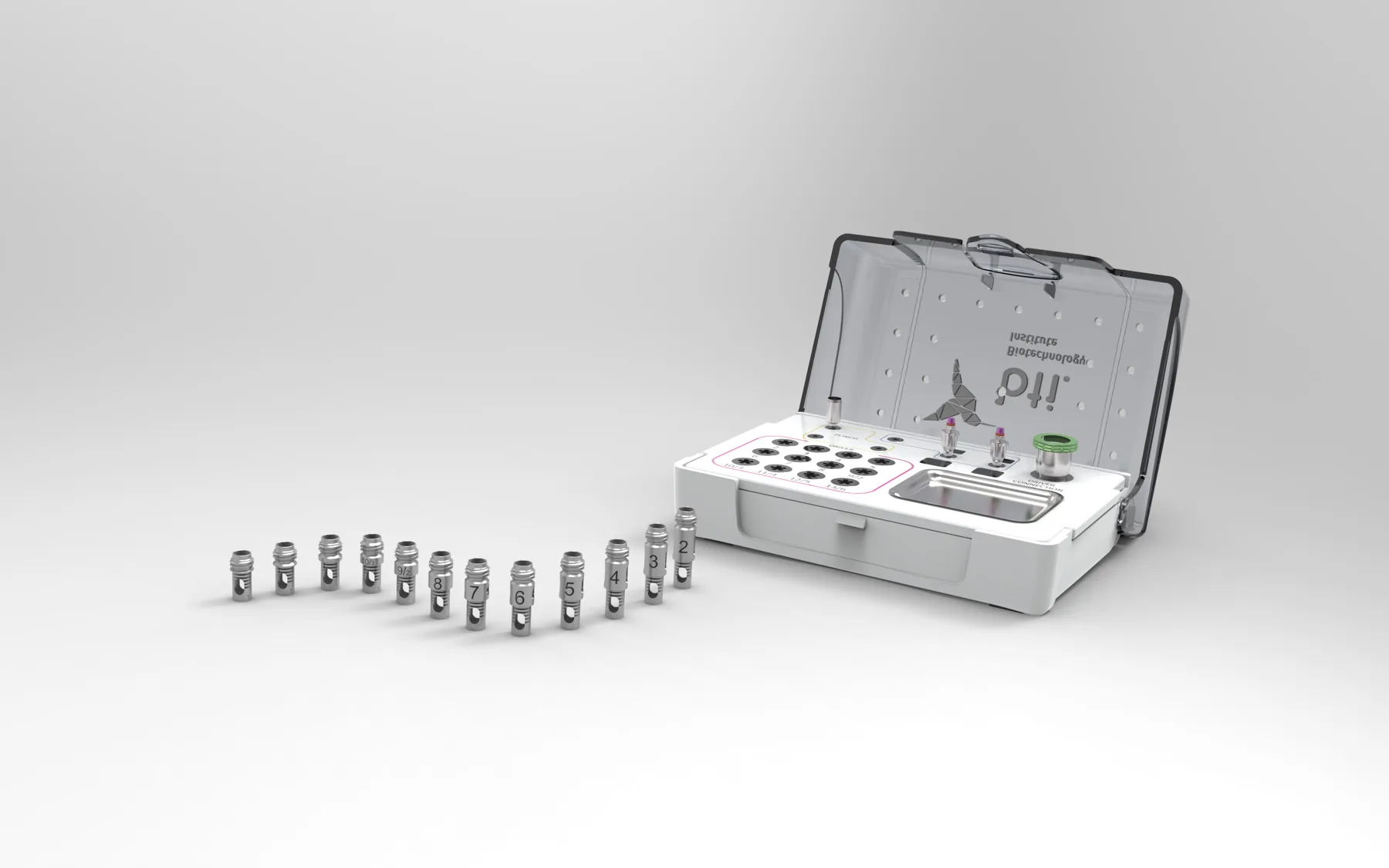
Stop & Guide® does not use dedicated guided drills. A driver of the right height is screwed onto the contra-angle connector, surrounds your conventional drill, slides into the titanium master sleeve of the guide and stops on it. Drill diameter and depth come from your usual CORE® sequence.
- A CBCT of the patient and a surface scan of the mouth (STL).
- A surgical guide designed in planning software with the specific BTI titanium master sleeves: SCG (standard platforms) or S3CG (3.0 platform), 5 mm high.
- A W&H WI-75 E/KM surgical contra-angle, compatible with the driver connector.
- The Stop & Guide® kit (KCG, or K3CG for the 3.0 platform) and the drill sequence for the planned implant dimensions — for CORE® narrow platform, the KCQ5-CGL guided drill kit with long-shank drills from Ø2.8 to Ø4.7 mm.
Piloted, semi-guided or fully guided — choose per case; the same kit serves all three and doubles as a drill-stop kit in freehand surgery.
The driver stops on the sleeve. If the ridge is not flat or the implant sits subcrestal, the 0.5 mm laser marks show the remaining depth and you switch to a shorter driver.
What Integra supplies for guided surgery
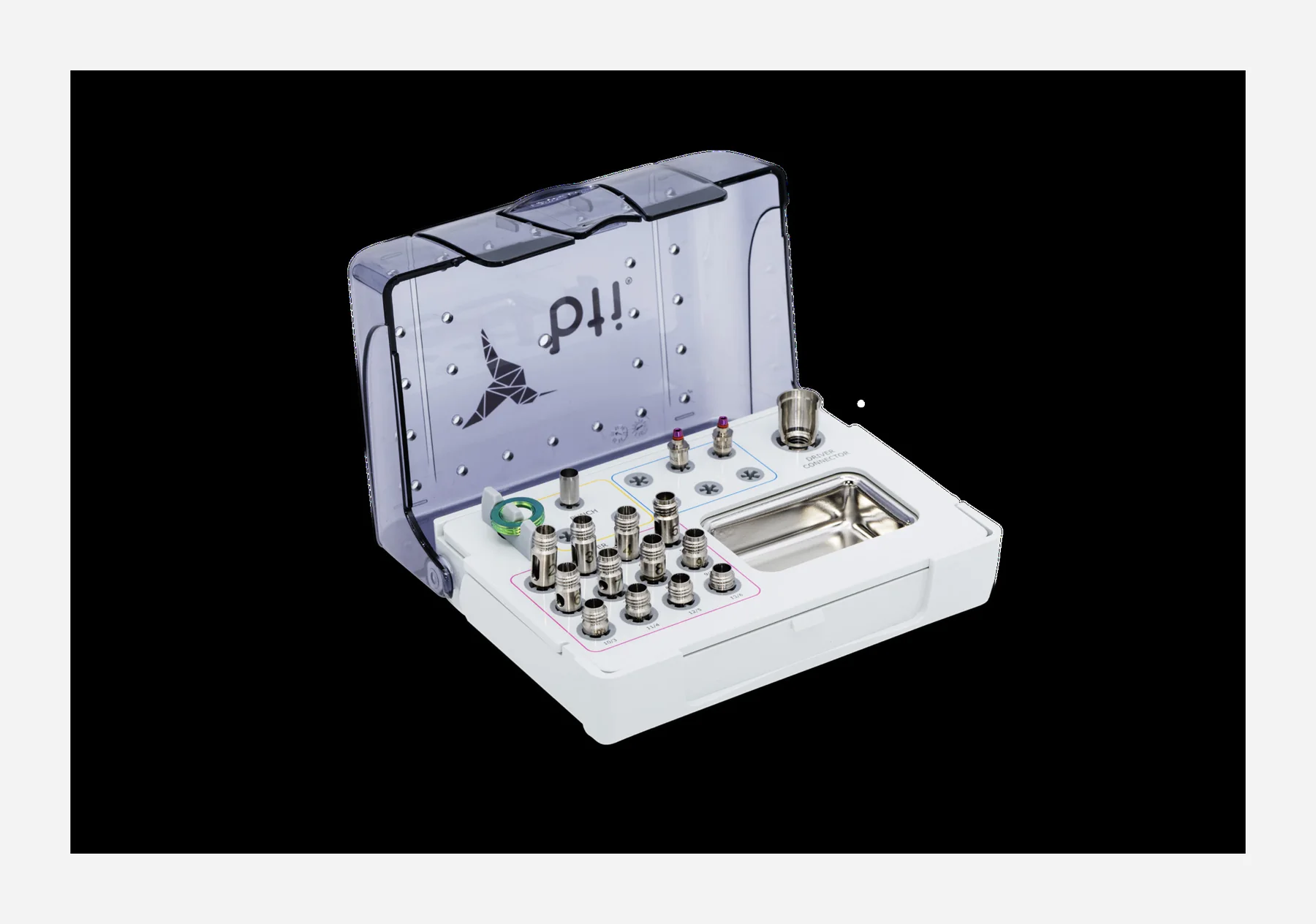
Different heights and diameters. Each driver surrounds the drill concentrically, is guided by the sleeve and stops on it; laser marks every 0.5 mm read the residual depth when the ridge is not flat or the implant is planned subcrestal.
Fits over the head of the W&H WI-75 E/KM surgical contra-angle and lets the selected driver be screwed in.
Checks that the initial part of the driver passes completely through the sleeve before drilling.
Drills the gingiva through the sleeve for a flapless approach.
Carry the implant through the guide. Transports for the different prosthetic platforms (PCG325 / PCG3 / PCGU) are ordered separately.
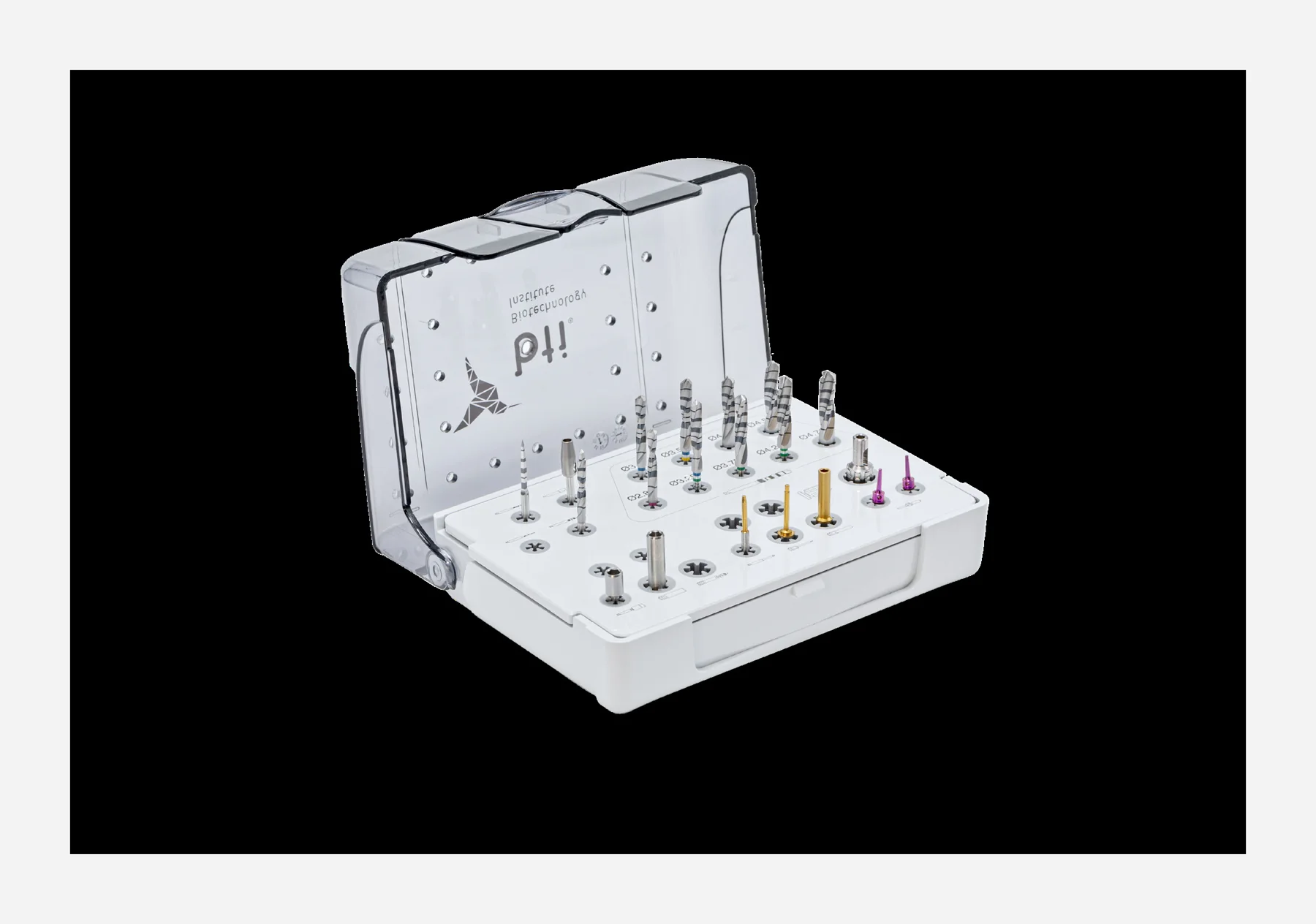
Both kits are stocked by Integra and lent for your first guided cases with a representative present. Master sleeves (SCG / S3CG) are supplied to the guide laboratory with the plan. Prices are in the client store for registered dentists.
One case across Integra and its partners
Integra is an independent distributor and stays focused on the implant system. Imaging, planning, guide manufacturing and laboratory work are contracted with the Photon.Group ecosystem, which knows the BTI libraries and kit. Photon Flow tracks the case across the partners.
- 01Photon Scan · partnerCBCT acquisition
Ultra-low-dose CBCT calibrated for the implant indication (adaptive field of view, 250 µm or finer for full-arch guide cases), delivered as DICOM within 24 hours. For dentate patients an intra-oral scan (STL) is added; edentulous cases use a dual-scan protocol with a marked scan appliance.
- 02Voxel3Di · partnerProsthetically-driven planning
CBCT and surface scan are merged; nerve, sinus and bone density are traced and the BTI CORE® implant is placed from the planned prosthesis backwards. The planning library carries the BTI INTERNA lines, the Stop & Guide® kit and the BTI master sleeve, so the plan is returned with sleeve selection and surgical protocol in 2 – 4 working days.
- 03Photon Lab · partnerGuide design and printing
Tooth-, teeth-tissue-, tissue- or bone-supported guides designed with the SCG / S3CG titanium master sleeves and printed in medical-grade resin. Full-arch and multi-implant cases use StackGuides™: a pinned base, optional bone-reduction level, osteotomy level, MULTI-IM® seating jig and a carrier for the immediate provisional.
- 04Integra · your clinicSurgery with BTI CORE®
Integra supplies the CORE® implants in the planned sizes, the Stop & Guide® kit and the CORE® guided drill kit — on loan for first cases, with a representative chairside. Piloted, semi-guided or fully guided, using your conventional drilling sequence.
- 05Photon Lab · partnerProsthesis on BTI components
Screw-retained restorations on MULTI-IM® trans-epithelials or square abutments (Ti-base), designed on the BTI digital libraries (every major CAD suite) and milled or printed in the partner laboratory: single crowns, bridges and full-arch titanium-bar zirconia.
CBCT and DICOM within 24 h · plan in 2 – 4 working days · single guide 3 – 5 working days, StackGuides™ 5 – 10 · definitive prosthesis 5 working days (48 h rush) after osseointegration.
Tooth-supported, teeth-tissue, tissue-supported (dual-scan) and bone-supported (open flap, most stable). Fixation pins are strongly recommended for tissue- and bone-supported and full-arch cases.
StackGuides™ keep bone reduction, pilot drilling, osteotomy, implant insertion and MULTI-IM® seating on one pinned reference. Angled 17° / 30° MULTI-IM® need rotation-indexed (timed) implant placement in the guide; 4.5 mm implants are restored on MULTI-IM® only.
Partner services are contracted with Photon.Group and priced by them; Integra coordinates the BTI components, kits and timing. Photon.Group and Voxel3Di are independent companies; StackGuides™ is their trademark.
Plan in your software, or in BTI Scan® 4
Stop & Guide® is software-agnostic: the guide only has to be designed with the SCG / S3CG master sleeves. BTI's scan-body and analogue libraries are available for every major CAD suite for the prosthetic side; the Photon.Group planning platform carries the BTI implant lines, kit and master sleeve for the surgical side.
BTI's own planning software renders any CBCT, determines the bone density at every point of the alveolar bone, marks structures at risk such as the inferior dental nerve, registers an STL model against the volume and lets you design the prosthesis virtually over MULTI-IM® and UNIT® components. Available through Integra on request.
Sources: BTI CAT268 Stop & Guide® (03/2025), BTI kit sheets KCG / K3CG / KCQ5-CGL, BTI CAT020 BTI Scan® 4, and the Photon.Group / Voxel3Di service descriptions. Stop & Guide®, BTI Scan®, CORE®, MULTI-IM® and UNIT® are trademarks of BTI Biotechnology Institute S.L.; W&H is a trademark of W&H Dentalwerk.